

Risk Management · 2025
In this section3 topics
Risk Management Policy & Plan
Policy & Plan Description
Risk Management
The Company continues to embed the sustainability and risk culture in our business strategy and operations at all levels. Starting from the Company’s leadership, the board of directors promotes and enforces consistent and effective sustainability and risk management, making it part of our organizational culture. The policy, framework, guidelines and structure of sustainability and risk management demonstrate formal communication. Employees are encouraged to have a positive attitude towards proper sustainability and risk management from their first day with Thai Company. This is consistently reinforced throughout their time with the organization, such as through the new joiner program, sustainability and risk management training, ongoing activities and internal news updates.
In order that the internal control system of the Company and/or Subsidiary Company may function efficiently, the Company Group hired out the Deloitte Touche Tohmatsu Jaiyos Advisory Company Limited to assume the responsibility of inspecting the Group’s internal control system (in the middle of 2023 to in the middle of 2026). Those conducting the internal inspection have prepared a report on the results of their inspection of the Group’s internal control system and presented their results of their inspection in a report directly to the Audit Committee continually on a regular basis every trimester. The Group made the corrections and operational improvements in the various processes in accordance with the proposals and recommendations of the internal inspectors.
In addition, sustainability and risk management is embedded in business planning, decisions and execution. Examples of key areas include: Strategic risks are considered in the strategy planning process and during the implementation of initiatives complying with the decided strategy. New strategic investments, including mergers and acquisitions (M&A), new types of business investment, and large capital expenditure are embedded in sustainability and risk management. The risk profile will be reviewed by the risk management committee for suggestions on the adequacy and appropriateness of the risk response, financial strategy and risks were managed closely and driven by Group Treasury and the Finance Shared Services function and comply with Group Financial Risk Management and Treasury Policy. The framework parameters and the acceptable risks are approved by the board of directors and used as the key communication and control tools for the management and treasury team.
The chief executive officer, who is the chairman of the sustainability and risk management working team, oversees the Company's risk management operations by presenting a quarterly risk management report to the audit committee, the board of directors and the sustainability and risk management committee every six months to ensure close risk management and monitoring and ensure that risks are maintained at acceptable levels.
The Company requires annual policy reviews to be consistent with business guidelines, and the sustainability and risk management committee closely monitors strategies and risk management.
Risk Management Policy and Plans
Risk Management Framework
The Company focuses on risk management under change from internal and external factors that may impact the business and has thus continuously managed risks according to COSO-ERM Framework, the global risk management standard. The risk management is an important element of all processes in the Company's business operations, and the sustainability and risk management committee and a sustainability and risk management working team are thus appointed to ensure efficient management of overall risk management throughout the Company.
In addition, the Company assesses risks and obstacles that may affect operations and performs the internal control system adequacy assessment on existing internal control systems to consider improvement approaches for operations for enhanced efficiency with the scope covering administration and management of various tasks within the Company. Furthermore, the Company has assigned and monitored the executives responsible for each department to ensure the implementation of guidelines for improving operations, as well as to ensure that relevant parties adhere to those operational guidelines for more efficient performance.
Risk Management Organization
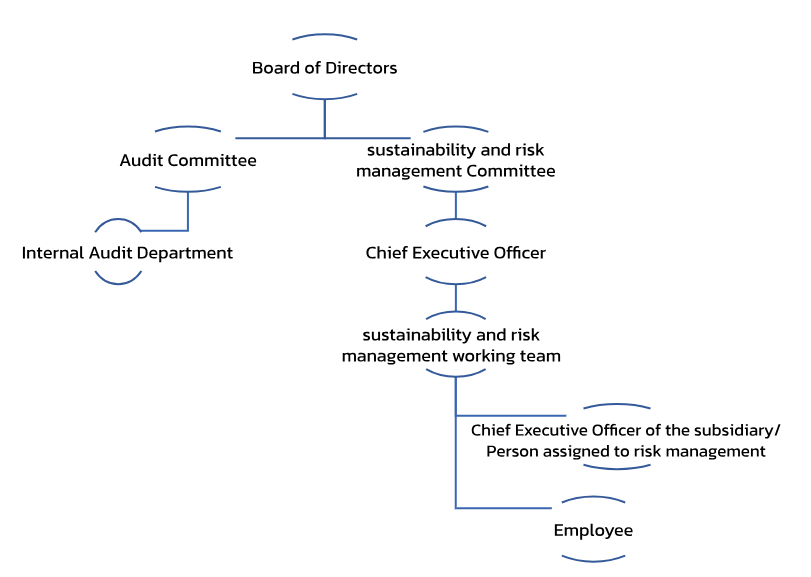
The Group has systematic and integrated risk management along with business strategy and plan formulation to ensure continuous risk management throughout the organization. Moreover, in order to ensure efficient and effective risk management, a risk management structure has been established consisting of the board of directors, the audit committee, the sustainability and risk management committee and sustainability and risk management working team. The Company has determined the risk management structure, roles and responsibilities are clearly established as follows:
The board of directors provides important oversight to enterprise risk management and is aware of and concurs with the entity’s risk acceptable level.
The audit committee has duties and responsibilities to review financial and accounting reporting system, internal control system, internal audit system and risk management system to ensure compliance with international standards, conciseness, suitability, modernity and efficiency. The Internal Audit Department has duties and responsibility to audit and review operations to ensure accuracy and compliance with the policies, guidelines, operational authority, regulations, laws and requirements of regulators.
The sustainability and risk management committee oversees risk management implementation and regularly reports risks and mitigations to limit existing and potential new risks to acceptable levels, consistently report and eliminate risks, and coordinate with the audit committee on key risks to ensure that the Company has appropriate internal control systems in place for risk management, including the implementation of appropriate risk management systems, compliance throughout the organization, and regular the board of directors reports on risks and management of key risks.
The chief executive officer is to ensure the appropriate and effective implementation of risk management throughout the organization.
The sustainability and risk management working team consists of the Chief Executive Officer, Chief Executive Officer of subsidiaries, and executives from each department who are directly aware of risk issues in their departments. Therefore, all risks that occur within the organization will be considered for operational guidelines and the results will be reported directly to the Chief Executive Officer and leads the implementation of risk management and provides guidance, the framework and process to subsidiaries.
Employees are responsible for managing risks in their areas of responsibility.
The Company manages risks systematically via the committee, working group, executives and employees to ensure efficient and effective risk management plans in line with the Company's goals and strategies, where operational risks are governed by the management responsible for respective operations while it is the responsibility of all units to manage and to keep risks at an acceptable level.
In this regard, for the chairman of both committees, the Company has appointed independent directors who have the qualifications, knowledge, abilities and independence according to the Corporate Governance Code to ensure that the Company has an effective and transparent risk management structure. Moreover, all independent directors are members of the board of directors. Therefore, important risk issues, including risk management, are acknowledged and managed by the board of directors.
To ensure that the Company's internal control system is effective, the Company has been commissioning Deloitte Touche Tohmatsu Jaiyos Advisory Co., Ltd. to conduct audit work since mid-2023 to mid-2025 to audit the Company's internal control system and continuously monitor the results of the Company's internal audit on a quarterly basis and present the report directly to the audit committee. The Company has always corrected and improved its departments’ operational systems based on the recommendations of the auditors.
For materiality risks, Key Risk Indicators, or KRIs, are set up and closely monitor movement. KRIs provide an early signal of increasing risk exposures in various areas of the enterprise and can be lagging and leading indicators. It is set to be every 6 months and is reported to the sustainability and risk management committee regularly.
Acceptable Risk Level
Acceptable risk level is an important factor to consider when the Company sets strategies and determines the direction of risk management. High and Medium-High are considered to exceed the acceptable level and require immediate actions or mitigation plans.
Risk Management Culture
All employees must have a common responsibility to support and follow risk management plans as well as creating atmosphere and culture in the risk management where the Company focuses on the proper allocation of resources and supports to promote effective risk management.
Risks to the Company's Business Operations
Risk Register
| Risk Name | Risk Characteristics | Consequences | Management Measures | Related Risk Factors |
|---|---|---|---|---|
| Risk from the Fact that Main Proportion of Income Comes from Small Group of Major Customers | The Company’s core business involves providing Digital Transformation consultancy, with a primary focus on the design and implementation of Customer Relationship Management (CRM) systems utilizing the Salesforce platform as the central technological pillar. For over a decade, the Company has maintained a robust relationship with Salesforce, achieving the highest tier of partnership as a Summit Partner. Furthermore, the Company has received strategic backing from Salesforce Ventures LLC, which has been a shareholder since 2020—a testament to the Company’s significance as a key partner in the ASEAN region. Despite these strengths, the Company’s revenue structure and service delivery remain significantly integrated with Salesforce technology, resulting in a concentration risk associated with a single supplier. The Company may be exposed to risks should there be uncontrollable changes in Salesforce’s management policies, Reseller Partner agreements, or partnership terms and conditions. | A failure to renew the official reseller agreement or a downgrade in partnership status could directly impact service costs. Specifically, the cost of Platform License Subscriptions might increase if the Company is forced to procure them through alternative channels or third-party intermediaries at less favorable rates. This would subsequently diminish gross profit margins and price competitiveness. Additionally, any negative change to the Summit Partner status could undermine brand image and client confidence regarding the Company’s expertise. Furthermore, technical disruptions or abrupt technological shifts by the supplier could lead to service interruptions, ultimately affecting the Company’s total revenue and operational stability. | The Company maintains full confidence in the Salesforce platform, recognizing it as a world-class CRM solution with superior efficiency and security. Delivering high-impact solutions requires the profound expertise and experience that the Company possesses as one of Salesforce’s leading partners in Thailand. To mitigate reliance risks, the Company is committed to maintaining its summit partner standards while continuously upskilling personnel to ensure technical agility. In the event that the Reseller Partner status is discontinued, the Company’s skilled workforce remains capable of consulting on, designing, and developing alternative CRM systems or other market-leading software. This flexibility allows the Company to pivot and align with clients’ Digital Transformation strategies using various platforms, thereby ensuring business continuity and reducing long-term dependence on any single technology provider. | 735 · Description: Reliance on large partners / distributors or few partners / distributors · Info category: STRATEGIC_RISK |
| The risk from the main revenue proportion which comes from a small number of main customers. | The Company’s primary revenue is derived from providing consultancy and system development services to large enterprises and government agencies. Between 2020 and 2025, the revenue contribution from the top three major customers accounted for approximately 60.9%, 42.30%, 47.57%, 16.35%, 24.32%, and 18.25%, respectively. It should be noted, however, that the composition of these major customers varies annually due to the project-based nature of the services, which typically involve implementation phases spanning 1 to 3 years. The Company consistently earns the trust of leading organizations across diverse sectors, including banking, telecommunications, retail, energy, state-owned enterprises, and educational institutions. While statistical data indicates a concentration of revenue, the diversity of the client's industries and the multi-year continuity of projects serve to mitigate overall revenue volatility. | A concentration of revenue among a limited number of major clients may impact the Company's financial stability if these clients shift investment policies, delay projects, or transition to competitors. Such actions could lead to a significant decline in revenue within a specific fiscal year. Nevertheless, the majority of the Company’s clients are SET-listed companies with robust financial positions and high corporate governance standards, as well as government agencies with secured budgets. Consequently, the Company faces minimal credit risk or default risk, which helps maintain a healthy and consistent cash flow. | The Company is proactive in addressing this risk through a strategic diversification of its client base, both domestically and internationally. Efforts are being made to expand services into the Small and Medium Enterprise (SME) segment to reduce reliance on large-scale accounts. Simultaneously, the Company focuses on fostering strategic partnerships by collaborating on long-term technology roadmaps and investment plans with existing clients to ensure project continuity and recurring development phases. Furthermore, the Company prioritizes long-term business planning to ensure that human resources and capital expenditures are managed efficiently and remain aligned with the Digital Transformation strategies of each client group, thereby securing sustainable revenue growth in the future. | 734 · Description: Reliance on large customers or few customers · Info category: STRATEGIC_RISK |
| Income Inconsistence Risk | The Company’s core business focuses on Digital Transformation consultancy, which is primarily project-based. Revenue recognition timing varies according to the project stages, complexity, and specific requirements of each client. Our service spectrum ranges from Digital Strategy and System Implementation to technology-related services, such as License and Subscription sales and Maintenance and Managed Services (MA). Due to this business model, the Company’s revenue is significantly influenced by the investment cycles and budgetary allocations of its clients. Periodical revenue fluctuations may occur if economic volatility or intensified market competition leads clients to defer investments, postpone service schedules, or pivot their strategic roadmaps. | While economic fluctuations may affect short-term revenue targets, the impact is mitigated by a robust client base consisting of leading organizations with high financial stability, particularly in the banking and energy sectors. These industries require continuous technological investment to maintain their competitive edge and Business Continuity. This resilience was evident in the 2025 performance; despite a broader economic slowdown driven by external factors and the lingering effects of COVID-19, the Company achieved year-on-year revenue growth. Our diversified portfolio across multiple industries allows for consistent cash flow management, even when specific sectors experience temporary downturns. | The Company is committed to restructuring its revenue model toward long-term sustainability by increasing the proportion of Recurring Income from Maintenance Agreements (MA) and Software Subscriptions. This strategy effectively cushions the impact of project-based volatility. Furthermore, the Company is proactively capturing opportunities within New S-Curve industries and sectors undergoing rapid digital acceleration, such as Healthcare, Modern Retail, and Smart Government initiatives. These segments exhibit high growth potential and a demand for increasingly sophisticated technological solutions. As the global landscape transitions into an AI and Data-Driven era, the Company is expanding into emerging technologies to create New Revenue Streams. By maintaining high-quality, End-to-End service delivery, the Company aims to remain the "Top of Mind" partner for enterprises across all sectors. This approach transforms the risks associated with revenue uncertainty into long-term opportunities for market share expansion. | 1725 · Description: Income volatility · Info category: FINANCIAL_RISK |
| Technology Migration Risk | As the Company’s core business involves providing Digital Transformation consultancy, it operates within a highly dynamic environment characterized by rapid technological advancements. Currently, technology plays a pivotal role across all business sectors and significantly influences daily life. The primary risk arises from disruptive innovations or new technologies that may supersede the existing solutions offered by the Company. If the Company fails to adapt, enhance its technical capabilities, or accurately anticipate market trends, its service offerings may lose their competitive edge or become obsolete in the eyes of its clients. | Failure to keep pace with evolving technological trends could significantly impact business operations, leading to a loss of competitive advantage, a decline in market share, and a diminished reputation as a technology leader. Furthermore, rapid shifts in the landscape may result in a skill gap, where the existing expertise of personnel no longer aligns with the requirements of new projects. This would directly affect the Company’s ability to generate revenue and sustain long-term financial performance. | The Company employs a proactive risk management strategy by maintaining close strategic alliances with world-class platform providers across various domains, such as Salesforce, MuleSoft, Google, Tableau, Splunk, Forcepoint, Proofpoint, Talend, and Elastic. These partnerships grant the Company early access to information, deep insights, and technology roadmaps, ensuring it remains well-prepared to pivot and refine its solutions ahead of market shifts. In addition, the Company continuously seeks new partners to diversify its product portfolio and provide clients with the most advanced options available. A dedicated Research & Development (R&D) unit has been established to monitor, study, and experiment with emerging technologies, transforming them into innovative products and services. Parallelly, the Company prioritizes Re-skilling and Up-skilling programs for its workforce to ensure continuous proficiency in evolving technologies. These combined efforts guarantee that the Company maintains its leadership position in delivering high-efficiency solutions to clients under any circumstances. | 732 · Description: Changes in technologies · Info category: STRATEGIC_RISK |
| Management and Personnel Dependence Risk | The Company’s core operations involve providing consultancy and developing complex information technology systems. Success in this field depends heavily on specialized software knowledge, technical proficiency, and extensive experience in integrating systems with clients' existing infrastructures. This includes the expertise required for system maintenance and providing critical technical support. Consequently, human resources are considered the Company’s most valuable assets and the primary engine for organizational growth. The Company faces a potential risk should there be a loss of Key Personnel with specialized expertise or high-level executives with strategic vision and strong partner relationships, as such losses could impair service delivery and operational efficiency. | The loss of specialized human resources could directly affect the continuity of ongoing projects and the Company’s ability to respond to client needs in a timely manner. In a highly competitive market for technology talent, staff turnover may lead to increased recruitment and training costs for new personnel. Furthermore, it may disrupt internal Knowledge Transfer. Failure to manage this risk effectively could undermine the Company’s competitive advantage and long-term profit growth targets. | Recognizing that employees are the heart of its success, the Company prioritizes strategic human resource management. A robust Succession Plan has been established for senior management and critical roles to ensure Business Continuity. Additionally, the Company implements systematic People Development programs and maintains a competitive compensation and benefits structure as part of its Retention Strategy to minimize turnover. The Company’s commitment to human capital management is reflected in the exponential growth of its workforce to support continuous business expansion. The number of employees has increased significantly from 168 in 2020 to 197 in 2021, and surged to 673 in 2022. This growth continued to 1,055 in 2023, 1,189 in 2024, and reached 1,353 in 2025. This consistent upward trend not only demonstrates the Company’s stability but also highlights its strong Talent Acquisition capabilities. By expanding the talent pool, the Company effectively mitigates the risk of over-reliance on specific individuals and redistributes expertise across a large, capable team prepared to perform at all levels. | 738 · Description: Reliance on employees in key positions · Info category: OPERATIONAL_RISK |
| Estimated Error Cost Risk | In providing Digital Transformation consultancy and information technology system development, human resource costs constitute the most significant operating expense and serve as the primary factor in determining project pricing. The Company prepares advance cost estimates by assessing the required headcount, specialized expertise, and anticipated man-hours. These estimates form the basis for entering into Fixed-Price Contracts with clearly defined service values. However, due to the technical complexity of system development and evolving client requirements, a risk exists where actual operational costs may deviate from the initial estimates. | Inaccuracies in cost estimation directly affect the Company’s financial stability and competitive positioning in two key dimensions. Firstly, if actual costs exceed estimates—for instance, due to the need for additional personnel or extended timelines to resolve complex technical issues—project profitability will decline, potentially resulting in an operating loss. Conversely, if costs are overestimated, the proposed pricing may become higher than market rates and competitors’ offers. This could lead to a loss of business opportunities and ultimately impact the Company's total revenue targets. | Recognizing the importance of optimal cost management, the Company has implemented rigorous operational procedures. A key measure is the mandatory involvement of the Project Delivery units in the resource and timeline assessment phase. This ensures that estimates are accurate and reflect the actual technical scope before being submitted for final review and approval by senior management. Furthermore, during project execution, the Company performs close monitoring through regular Actual vs. Budget Analysis reports. This enables the timely identification of issues and ensures that tasks are completed within the defined budgetary framework. The Company also conducts Post-Project Evaluations to perform in-depth analyses of past challenges or discrepancies. These insights are utilized as a benchmark to enhance the precision of future cost estimations, ensuring they are both efficient and equitable for all stakeholders. | 1725 · Description: Income volatility · Info category: FINANCIAL_RISK |
| Risks of Changes in Consumer Behaviors | In the current era, the global business landscape is characterized by hyper-change, driven primarily by the continuous and rapid advancement of innovations. These innovations often trigger widespread mass adoption, fundamentally altering how consumers live, shop, and access services. Consequently, consumer behaviors have become increasingly complex and difficult to predict. The Company faces a strategic risk if emerging technologies better address consumer needs or cause a total shift in market preferences. As a digital transformation consultant, if the Company fails to anticipate these trends or adapt its solutions accordingly, its business propositions may lose their market relevance and appeal. | A failure to promptly adapt to evolving consumer behaviors could significantly impair the Company’s competitive advantage. Since the Company’s clients—various business organizations—require solutions that effectively engage modern consumers, a lack of technological readiness may result in the loss of major project opportunities or the defection of existing clients to competitors offering more resonant technologies. Such outcomes would directly impact long-term revenue growth and the overall sustainability of business performance. | The Company is acutely aware of the volatility in consumer behavior and has adopted a proactive stance by establishing a specialized task force dedicated to monitoring technology trends and analyzing consumer patterns. This team conducts in-depth studies to evaluate the potential and impact of new technologies, providing regular briefings to senior management. These insights serve as a critical foundation for refining the Company’s agile strategy. Specifically, as modern consumers increasingly prioritize hyper-personalization through Artificial Intelligence (AI) and robust data privacy, the Company is focusing on developing solutions that integrate advanced data analytics with international security standards. This ensures that the systems developed by the Company meet the genuine needs of both clients and end-consumers with maximum efficiency and timeliness. This strategic approach allows the Company to transform the risks of change into opportunities for sustainable innovation, driving digital transformation in the modern world. | 729 · Description: Behavior or needs of customers / consumers · Info category: STRATEGIC_RISK |
| Investment Risk | While the Group’s core strategy focuses on driving continuous growth within its primary operations, the Company actively seeks opportunities to diversify across the value chain. This expansion targets businesses that complement or enhance the Group’s core capabilities, such as strategic and IT consultancy, integrated support services, Internet of Things (IoT), Big Data Analytics, Cloud Computing, and IT personnel management. Additionally, the Company explores new ventures capable of generating value-added co-products and high-margin growth, particularly within innovative technology sectors. | If investment projects do not proceed according to plan or fail to yield estimated returns, the Company’s financial position and liquidity could be adversely affected due to the substantial CAPEX involved. Furthermore, failures in post-merger integration or the mismanagement of new business lines where the Company may lack specialized expertise could lead to the loss of business opportunities and valuable human capital. Such setbacks could also undermine the confidence of investors and stakeholders, especially if projects encounter unforeseen regulatory hurdles or sustainability-related complications. | The Company has established systematic risk management measures to balance growth opportunities with loss prevention. Investment projects are prioritized based on their strategic alignment with corporate goals, focusing on initiatives that drive revenue and net profit growth while maintaining a robust financial position. The Company employs a rigorous investment screening and decision-making process led by the Executive Committee, which comprises qualified experts. High-value or high-risk projects must undergo evaluation by the Sustainability and Risk Management Committee to assess suitability and define risk mitigation measures before being proposed to the Board of Directors. Once a project is approved, the Risk Management Department or designated officers are responsible for closely monitoring progress and emerging risks. Status updates are reported to the Audit Committee quarterly and to the Sustainability and Risk Management Committee every six months. This oversight ensures that operations remain within the established scope and budget. Furthermore, the Company performs continuous problem analysis to refine its investment risk management efficiency consistently. | 1716 · Description: New business risk · Info category: STRATEGIC_RISK |
| Risk from corruption | The Company operates its business based on principles of integrity, transparency, and fairness, strictly adhering to legal frameworks and business ethics. Nevertheless, corruption risks remain a potential factor in various operational processes, including procurement, regulatory liaison, and high-value transactions. Consequently, the Company prioritizes regular corruption risk assessments, founded on the conviction that such risks can be effectively managed and prevented through robust internal control systems. This includes the Segregation of Duties and a clear organizational structure designed to prevent any single individual from having absolute decision-making authority over critical processes. | Any occurrence of internal corruption would severely damage the Company’s reputation and credibility among all stakeholders, including clients, business partners, and shareholders. Furthermore, it could lead to significant financial loss, legal penalties, or debarment from bidding processes, particularly for government projects. Demonstrating its unwavering commitment to good corporate governance, the Company has been a certified member of the Thai Private Sector Collective Action Against Corruption (CAC) since February 7, 2020. This certification was subsequently renewed on March 31, 2023. Currently, the Company is in the process of seeking its next recertification (due in 2026) to reaffirm the continuous readiness and standardized nature of its anti-corruption systems. | The Company mandates strict control and audit measures for high-risk operational processes. The Internal Audit department is responsible for assessing risks and performing spot checks to deter any actions susceptible to corruption. Additionally, the Company provides a secure and transparent Whistleblowing channel, allowing stakeholders to report grievances or suspicious activities directly to the Audit Committee. The investigation process is systematic, transparent, and fair to all parties, with summary reports presented to the Audit Committee on a quarterly basis. In the past year, the Company identified no material deficiencies related to corruption, discrimination, breaches of business ethics, or violations of antitrust and competition laws. Furthermore, there were no fines or penalties imposed by regulatory authorities. These results reflect the effectiveness of the Company’s robust corporate governance framework and its excellence in risk management. | 754 · Description: Corruption · Info category: OPERATIONAL_RISK |
| Risk of PDPA | As the Company’s core business involves Digital Transformation consultancy and information technology system development, operations necessitate the access and processing of extensive datasets, including the personal data of employees, business partners, and clients. Consequently, activities related to the collection, use, or disclosure of personal data carry the risk of non-compliance with the Personal Data Protection Act B.E. 2562 (PDPA). Given the complexity of this legislation and its continually evolving guidelines, any internal processes or data management practices that lack sufficient security standards—or the unauthorized use of data without explicit consent—could lead to a breach of data subjects' rights. | Failure to strictly comply with PDPA requirements could severely damage the Company’s reputation and credibility as a technology expert. Furthermore, non-compliance entails significant legal risks, including civil, criminal, and administrative penalties, as well as substantial fines. Litigation and claims for damages from data subjects could adversely affect the Company’s financial position and business continuity. Such incidents would also undermine the confidence of leading corporate clients who prioritize data security standards as a critical requirement. | The Company is committed to rigorous legal compliance and undergoes audits by independent external assessors to verify the integrity of its operational processes. To ensure ongoing alignment with the law, the Company has appointed a dedicated working group and a Data Protection Officer (DPO) to oversee policies and procedures. lKey measures implemented include conducting Data Protection Impact Assessments (DPIA), establishing Data Processing Agreements (DPA) with business partners, and maintaining a systematic Consent Management framework along with clear channels for data subjects to exercise their rights. Furthermore, the Company prioritizes continuous training and awareness programs for both executives and employees. These initiatives ensure that all personal data processing is conducted accurately, transparently, and in accordance with the highest international security standards. | 758 · Description: Violations of laws and regulations · Info category: COMPLIANCE_RISK |
| Sustainability Risk (Environmental, Social and Governance : ESG) | As a specialist and consultant in Digital Transformation, the Company is committed to driving the digital economy through innovation in Customer Relationship Management (CRM) and data analytics. However, sustainability risks may arise if the Company fails to align its operations with the increasingly stringent ESG standards prioritized by partners and investors. Key risk factors include energy consumption management in data centers, maintaining Digital Trust through robust data security, and the shortage of skilled digital talent—all of which are critical to the growth of a sustainable digital ecosystem. | A lack of effective ESG management could undermine the Company’s long-term competitiveness and growth trajectory. Specifically, it may result in lost opportunities to collaborate with global partners or large corporate clients that enforce Green Procurement policies. Furthermore, failure to upscale human capital to keep pace with technological shifts could disrupt the Company’s role in driving the digital economy. Such setbacks would directly impair stakeholder confidence and potentially lead to higher operational costs due to inefficient resource management. | The Company is dedicated to operating with a strong sense of responsibility toward the environment, society, and corporate governance. We integrate sustainability dimensions into our core corporate strategy by fostering a resilient digital economy, society, and environment. The Company prioritizes Human Capital Development and the strategic application of technology to optimize resource efficiency. These efforts are underpinned by a steadfast commitment to business ethics and Good Corporate Governance. By balancing economic growth with social and environmental stewardship, the Company aims to achieve sustainable development while minimizing adverse impacts on all stakeholders. | 1717 · Description: ESG risk · Info category: STRATEGIC_RISK |
| Financial Liquidity Risk | The Company faces potential liquidity risk due to the nature of its business, which primarily consists of project-based and contract-driven services. Consequently, revenue recognition may fluctuate in accordance with economic conditions. During an economic slowdown, clients may delay payments, request project extensions, or the Company may fail to acquire new clients as targeted. Conversely, the Company’s primary cost structure is dominated by personnel expenses, which are fixed costs requiring continuous settlement. This potential mismatch between the timing of cash inflows and outflows could lead to a shortage of operational working capital. | An inability to maintain sufficient cash flow to meet financial obligations as they fall due could adversely affect the Company’s business continuity, as well as the confidence of business partners and financial institutions. Nevertheless, between 2022 and 2025, the Company maintained a robust financial position, reporting current ratios of 1.66, 1.56, 1.85, and 2.01, respectively. These figures reflect the Company’s consistent ability to generate revenue and maintain efficient collection processes, even amidst challenging economic environments. | The Company manages this risk through a rigorous annual budgeting process and regular performance monitoring. A key strategy involves diversifying revenue streams by expanding the client base toward SET-listed companies with strong financial foundations. Prior to project commencement, the Company performs financial health analyses on potential clients to determine appropriate payment terms and credit limits. Additionally, the Company closely monitors accounts receivable to ensure that cash inflows align with planned expenditures. Furthermore, the Company maintains adequate levels of liquid assets and credit facilities to serve as a buffer against any unforeseen future volatility. | 1724 · Description: Liquidity risk · Info category: FINANCIAL_RISK |
| Exchange Rate Risk | The Company is exposed to foreign exchange rate volatility due to its core business activities, which involve the direct procurement of software and licenses from international vendors. These transactions are primarily denominated in US Dollars (USD). The risk arises from fluctuations in the value of the Thai Baht (THB) against the USD during the period between the transaction date and the actual settlement date. Such volatility may cause the Company’s operational costs to vary in accordance with foreign exchange market conditions. | Fluctuations in the THB/USD exchange rate directly affect both the Company’s revenue and expenses. An appreciation of the Thai Baht results in decreased THB-denominated sales revenue for USD-based transactions, while simultaneously lowering software procurement costs. Conversely, a depreciation of the Thai Baht increases costs alongside higher recognized revenue. However, since the Company typically quotes software sales prices to most clients in USD to align with its procurement costs, a Natural Hedge is established. This strategic alignment effectively mitigates the impact of currency fluctuations on the Company’s gross profit margins to a significant extent. | The Company prioritizes a prudent approach to foreign exchange risk management. Beyond the Natural Hedge strategy, the Company utilizes additional financial instruments to further mitigate exposure, such as Foreign Exchange Forward Contracts when appropriate. These instruments allow the Company to lock in costs and ensure cash flow certainty. The Company maintains a strict policy that financial instruments are to be used solely for hedging operational risks arising from normal business activities. The Company has a definitive policy against speculative trading in foreign exchange. This disciplined approach ensures the long-term financial stability of the Group. | 764 · Description: Fluctuation in exchange rates, interest rates, or the inflation rate · Info category: FINANCIAL_RISK |
| Risk of Receiving Payment from Accrual Service Revenue | Unbilled Revenue, or Contract Assets, represents the value of work performed and recognized as cumulative revenue based on the stage of completion, for which the contractual billing milestones have not yet been reached. These items are reclassified as Trade Receivables once the Corporate Group issues an invoice in accordance with the terms of the service agreement. As of the end of 2025, the Corporate Group reported Contract Assets totaling 770 million Baht, accounting for 20.43% of total assets. Given its significance to the asset structure, the primary risk involves potential delays in payment or uncertainty in collection should the delivered work fail to meet the specific conditions or milestones agreed upon in the contract. | Any inability to deliver work according to the established schedule, or disputes regarding the quality of deliverables that prevent the issuance of invoices as planned, would directly impact the Company's liquidity and operational cash flow. Furthermore, if a client’s financial position weakens to the point of insolvency, the Company may be required to recognize an Expected Credit Loss (ECL). Such a provision would inevitably have a negative impact on the net profit and overall financial performance for that fiscal period. | The Company manages this risk systematically throughout the entire project lifecycle. This begins with a rigorous credit assessment and financial health review of potential clients before project acceptance and credit limit approval. During implementation, project teams maintain close coordination with clients to monitor satisfaction and ensure that the quality of work strictly adheres to contractual specifications, thereby minimizing errors prior to milestone submissions. Additionally, the Company has established clear loss-control measures, including concrete debt-following procedures and a policy to suspend operations if a client’s payments are overdue beyond the defined period to limit further financial exposure. Status reports on receivables and unbilled revenue are regularly presented to management to ensure efficient collection and maintain the Company's long-term financial stability. | 1724 · Description: Liquidity risk · Info category: FINANCIAL_RISK |
| Current and Emerging Risks - Cybersecurity | The Company also gives importance to emerging risks by performing risk analyses and assessments and has found that the Company has risks related to the COVID-19 pandemic, risk from cyber threats (Cyber-attacks). Cybersecurity The rapid shift toward digital workflows and an increased reliance on technology for coordination have resulted in cyberattack vectors becoming significantly more complex and diverse. These risks manifest as attacks on critical infrastructure and software, leading to operational downtime, as well as unauthorized access to sensitive or confidential data belonging to the Company and its clients for malicious use. As these threats continually evolve with sophisticated techniques, the Company faces the ongoing challenge of maintaining information security systems that remain resilient and up-to-date against the shifting landscape. | Cyber threats directly impact both financial stability and operational continuity. System disruptions may result in the Company’s inability to deliver projects as contractually obligated, leading to high system recovery costs. Furthermore, the leakage of confidential data could trigger significant fines or legal penalties from regulatory authorities under relevant laws. Most critically, such incidents cause severe damage to corporate reputation and brand image, which directly undermines the long-term trust of stakeholders and clients. | The Company places the highest priority on comprehensive cybersecurity and IT governance by integrating infrastructure, policies, technology, and personnel. Under the leadership of the Chief Executive Officer (CEO), who chairs the Information Technology Security Policy Committee, guidelines are established to align with business objectives and effectively prevent threats. The Company has laid a solid foundation through a clear cybersecurity framework and an incident response plan, complemented by investments in network-level protection and 24/7 continuous monitoring. Additionally, the Company has implemented an IT Disaster Recovery Plan (IT DRP) to ensure business continuity via backup systems during emergencies. The Company regularly conducts drills for both its threat response and Business Continuity Plans (BCP) to prevent disruptions to core activities. Moreover, there is a strong emphasis on fostering cybersecurity awareness and promoting cyber resilience among management and staff at all levels. This ensures the organization can adapt flexibly to crises, thereby maintaining confidence and protecting the long-term interests of all stakeholders. | 744 · Description: Information security and cyber-attack · Info category: OPERATIONAL_RISK |
Risks to Securities Holders' Investment
Risk Register
| Risk Name | Risk Characteristics | Consequences | Management Measures | Related Risk Factors |
|---|---|---|---|---|
| Risk from stock price changes | The market price of the Company’s common stock is subject to ongoing volatility, driven by a combination of internal factors within the Company’s control and uncontrollable external variables. These include the Company’s operational performance, shifts in government policies, changes in relevant laws and regulations, overall economic conditions, and prevailing sentiments within the capital market. Such factors serve as key variables that induce uncertainty in the share price, which may, at certain intervals, result in a market price that does not accurately reflect the Company’s intrinsic fundamental value. | Share price volatility directly impacts shareholders and investors, potentially resulting in returns—whether through dividends or capital gains—that fall short of expectations. In severe cases, significant price depreciation poses a risk of partial or total loss of investment principal. From a business perspective, excessive volatility may undermine the perceived stability of the Company and affect the confidence of institutional investors and stakeholders. This could ultimately create hurdles for future capital raising activities intended for business expansion. | The Company manages this risk by focusing on delivering stable and sustainable operational growth to reflect its true enterprise value to investors. Adhering to the principles of Good Corporate Governance, the Company ensures that all material information essential for investment decisions is disclosed accurately, transparently, and equitably through the Stock Exchange of Thailand (SET) channels. Furthermore, the Company places a high priority on Investor Relations (IR) to consistently communicate business strategies and performance results to the investment community. This proactive engagement aims to reduce information asymmetry or misconceptions that could lead to unnecessary price fluctuations. By striving to provide consistent returns to shareholders, the Company seeks to build and maintain long-term investor confidence. | 768 · Description: Return from investment of securities holder · Info category: HOLDER_RISK |